• Skip to main content

HRBWA

Humboldt River Basin Water Authority

  • Home
  • About HRBWA
    • Mission Statement
    • Board of Directors
    • Roles and Responsibilities
    • History
    • Staff
  • Meetings
    • HRBWA Meetings
  • Events
  • News
    • HRBWA News and Updates
  • Resources & Documents
    • Groundwater Rights Retirement Program
    • Humboldt Working Group
    • Water Rights
  • Advocacy
    • Nevada
    • Federal
    • Resolutions and Policies
    • Legal Activities
  • Contact Us
    • Related Links
Home / Archives for Jeff Fontaine

Jeff Fontaine

NDWR to hold public meeting on Extension of Time Regulations

September 25, 2024 By Jeff Fontaine

The Nevada Division of Water Resources is reviewing NAC §§ 533.390–533.500, which govern applications for extensions of time to complete construction or apply water to beneficial use, to determine if amendments or repeals are necessary. A public meeting will be held on October 15, 2024, at 1:00 p.m. in the Bonnie Bryan Conference Room at the Department of Conservation and Natural Resources in Carson City. Stakeholders are invited to discuss the Extensions of Time process, including the impact of existing regulations and potential areas for revision.

Click here for the public meeting notice.
The past and future of the Humboldt River

July 3, 2024 By Jeff Fontaine

DANIEL ROTHBERG July 2

The Humboldt River is Nevada’s river.

Unlike the Truckee River or the Walker River, the Humboldt is fully enclosed within the state’s boundaries, from its headwaters to its terminus. It is a river characteristic of the Great Basin. That is to say its waters do not reach the ocean. They get trapped in a closed valley, a land once inundated by ancient Lake Lahontan during the last Ice Age. It is a small river by diameter, and its flows are variable. Mark Twain, in Roughing It, joked about jumping across it and drinking the river dry to cool down on a hot day.

Even in Nevada, it is not in the news as often as the Colorado or the Truckee, two of the primary drinking water sources for Las Vegas and Reno. But it is at the center of deliberations over how the state might manage water into the future, with potential consequences for other parts of the Great Basin. What happens next could matter for many because the Humboldt River Basin serves as the economic backbone for rural counties in northeastern Nevada. Without it, communities would not exist as they do.

And the issue the Humboldt faces is one so common across the West: There are more legal rights to use water than there is water to go around. It’s a major problem, and policymakers are under pressure to fix it. I spent some time thinking about it this last week, not in front of my computer, but while driving down I-80 to do some reporting.

The river and the conflict

If you’re driving from Reno east toward Salt Lake City, you’re going in the opposite direction of the river, and it’s a route that roughly tracks the conflict over water.

At the end of the river and about an hour into my drive is the town of Lovelock, and the surroundings change quickly as arid land gives way to green agricultural fields.

Farmers in Lovelock claimed water here first in time. That means under state water law, they hold “senior” rights and an ability to get their full water allocations before those upstream. In these rights, the farmers in Lovelock hold a lot of legal power.

But over the past two decades, they haven’t been getting their full allocation. A water manager representing Lovelock has said in that time, they’ve ended up with no water for three of those years and less than 50% of their water for nine of the years. Some of that is drought. Some of it is what is taking place upstream. It’s not that irrigators on the Humboldt are diverting more than their fair share from the river’s surface. It’s that in the past ~50-70 years, irrigators and mines have sunk more and more wells into the ground, pumping groundwater from surrounding aquifers connected to the river. As more water is pumped, less groundwater makes it to the river and down to Lovelock.

Put another way, the water is captured or intercepted by groundwater pumping.

A very general summary of the science, but you get the idea. Once you get a few more miles down I-80, you can see what they are talking about with your own eyes as the lower Humboldt gives way to a middle segment. Not too far from the highway and the town of Winnemucca in Humboldt County, there are dozens of center-pivots that rely on groundwater pumping. Even farther along I-80, you hit the town of Carlin. Nearby, massive gold mines have sunk deep groundwater wells needed to dewater open pits (in order to mine beneath the groundwater table, operations must clear the area of water).

Much of the water used up here is backed by lower-priority water rights, and that’s because a lot of the water used to irrigate fields or dewater mines is groundwater.

With rural electricity, improvements in drilling technology and better understandings of hydrology, people started to claim more and more groundwater rights in the ~1950s on, years after the surface water was claimed. That might not sound like a big deal, but what that means from a water rights standpoint — where “first in time is first in right” — the groundwater users have a lower priority to use water from the Humboldt River than those downstream in Lovelock. Stated another way, because surface water downstream in Lovelock developed before groundwater upstream in Winnemucca, Battle Mountain, Carlin and Elko, farmers in Lovelock have a priority to the river.

It’s a point of contention because even as Lovelock farmers have seen less water over the past two decades, groundwater users have been allowed to continue pumping. For a decade now, Lovelock farmers have wanted the state to do something about it — get the state to curtail groundwater users and prevent the capture of their surface water.

It’s been hugely controversial because of how embedded groundwater pumping is in agricultural and mining activities that support towns like Winnemucca and Elko. Not only that, figuring out how to curtail pumping to physically get water back to the river is no easy feat. There is a lag time in how groundwater moves through the subsurface. So if groundwater pumping was shut off tomorrow, it wouldn’t fix the issue overnight.

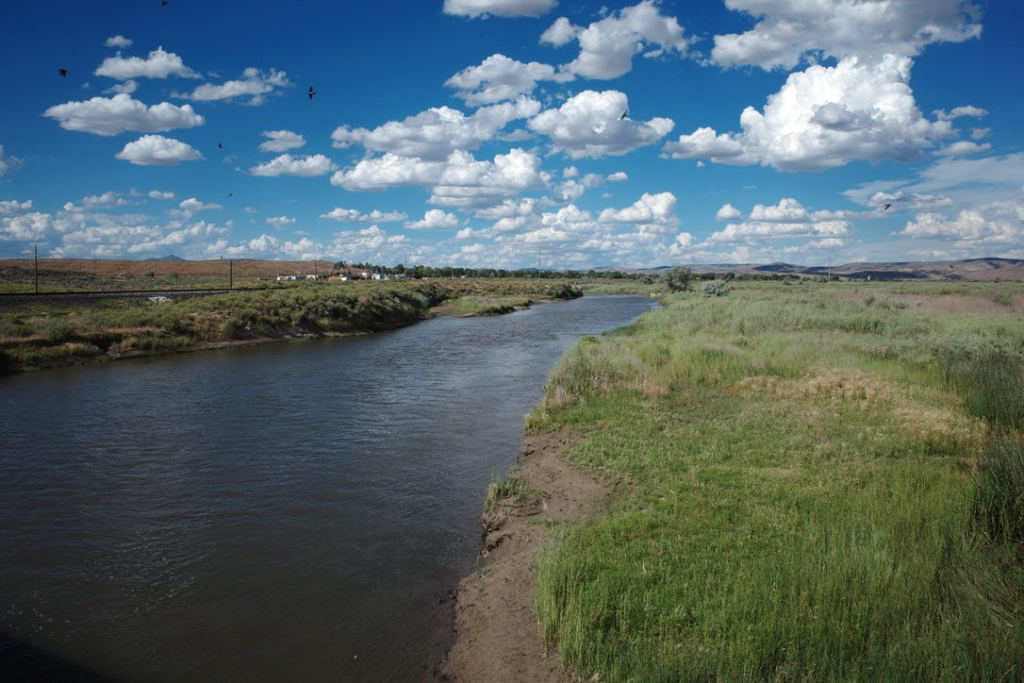
Rye Patch Dam upstream of Lovelock.

Why this matters now

So the vexing question remains: What do you do about it?

There has been litigation and settlements, litigation and compromises. But now the state again is moving to do something about it, and the stage is finally set for action.

For the past year, the state has been looking to shore up its legal authority to manage groundwater’s impact on surface water, an issue taken up first in the state legislature.

In Carson City last year, a coalition of water groups pushed legislation to recognize the hydrologic connection between ground and surface water, historically managed as separate sources. For years, there was legal uncertainty about what authority the state had to manage the two together. The bill tried to clarify that, noting the two sources can conflict (i.e. the issue on the Humboldt). Soon after the legislation was introduced, lobbyists stormed into the natural resources committee and eventually killed it. They included the state’s largest mining company, which the New York Times wrote about.

But it was hardly only Nevada Gold Mines that opposed the legislation. A lot of major interests testified against the legislation (Strange as it is to say, I actually thought the Times article both overstated and understated the mines’ influence. For instance, it did not include the PAC money it has donated to Democrats and Republicans or its large ranch holdings in the Humboldt Basin. At the same time, having reported on the bill, the mines were not the only driver of the opposition). Anyway, I digress. My point is that the legislation died and there were powerful groups that sought to shut it down. My second point is that this issue affects a lot of powerful interests across the state.

The more important dynamic was what was going on in the courts.

In the background, ongoing litigation was continuing to simmer along the Humboldt River over a state water order geared toward managing groundwater pumping. In fact, Nevada Gold Mines actually asked the state Supreme Court to restrict the state from enforcing the order, a request that a panel of three justices denied. At the same time, the Nevada Supreme Court was considering another related case on a similar topic.

And in January of this year, the court published a unanimous ruling that concluded the state “has authority to conjunctively manage surface waters and groundwater” as a connected source. The case was not about the Humboldt River but it put the state on greater legal footing that it could manage the effects of lower-priority groundwater pumping on rivers and springs when it conflicts with higher-priority surface rights.

Clarifying this authority was the easy part though.

How to actually manage the Humboldt River Basin conjunctively remains a tough question. Since last summer, the state has held workshops to solicit ideas for how to move forward. If you truly want to nerd out, the meetings are online. And earlier this year, after the workshops ended, it impaneled a working group on how to go forward.

That group has started meeting.

I’m not sure what the state will do or what will happen next, though I’m guessing it will all take time. Still, I do think it’s worth watching. The Humboldt could end up serving as a prominent test case for how the state might go about managing surface water in conjunction with groundwater pumping — an issue in many places (thus the widespread attention in the legislature last year, coming from many varied corners).

Division of Water Resources proposing new regulations pertaining to hearing procedures

June 10, 2024 By Jeff Fontaine

The Nevada Division of Water Resources is proposing new regulations and amendments to existing regulations pertaining to hearing procedures set forth in Chapter 533 of Nevada Administrative Code (NAC). A workshop has been set for: Monday, June 24, 2024, at 10:30 a.m.

The purpose of the workshop is to solicit oral and/or written comments from interested persons on rules of procedure for hearings before the State Engineer and pre-hearing procedures including a meet and confer between the parties. This is building from the amendments first proposed under R125-20, and intended to have continued under R142-22.

Workshop materials are available on the Division’s website at: http://water.nv.gov/

Nevada Division of Water Resources announces representatives to the Humboldt Stakeholder Working Group

June 1, 2024 By Jeff Fontaine

The Nevada Division of Water Resources has announced the representatives who have been chosen to participate in the quarterly Humboldt Stakeholder Working Group meetings. The representatives and their respective positions are listed in the table below. In cases where more than one person is listed for a position, the second name indicates a designated alternate. Four of the representatives are associated with the Humboldt River Basin Water Authority; Pershing County Commissioner Shayla Hudson, HRBWA Chair Bennie Hodges, Eureka County Alternate Board Member, Sabrina Tomera Reed, and HRBWA Executive Director, Jeff Fontaine. The group’s first meeting will be held in Elko on June 25.

PositionsIndividual name
County 1Zach Woodbury
County 2Shayla Hudson
Municipal Supply/City 1Jim Kerr/Dale Johnson
Municipal Supply/City 2James Eason
Industrial 1Brigid McHale (NV Energy)
Conservancy RepEd James
Mining 1Joel Donalson
Mining 2Steve Skidmore
Irrigation (UG) 1Kendle Bowler
Irrigation (UG) 2Sam Routson/Kade Crawford
Irrigation (SW) 1Sabrina Tomera Reed
Irrigation (SW) 2Bennie Hodges
At-Large 1Jeff Fontaine
At-Large 2Doug Busselman
EnvironmentalLaurel Saito
Legal 1Therese Stix/Caitlin Skulan
Legal 2Sev Carlson
Water Rights 1Chris Mahannah
Water Rights 2Dawn Aragon
Hydrogeology 1Jay Dixon
Hydrogeology 2Dwight Smith
EconomicsMichael Taylor

NDWR announces Humboldt River Working Group Membership

May 9, 2024 By Jeff Fontaine

In response to NDWR’s call for nominations for the Humboldt River working group, NDWR received more than 45 nominations. From these nominations, and based on past participation, letters of recommendation, and the desire for broad representation, NDWR selected 22 individuals including four from the Humboldt River Basin Water Authority; Shayla Hudson, Bennie Hodges, Sabrina Tomera Reed and Jeff Fontaine. The full member list is shown below. The first meeting for the working group is planned for late June.

County 1 Zach Woodbury
County 2 Shayla Hudson
Municipal Supply/City 1 Jim Kerr/Dale Johnson
Municipal Supply/City 2 Steve Skidmore
Industrial 1 Brigid McHale (NV Energy)
Conservancy Rep Ed James
Mining 1 Joel Donalson
Mining 2 Steve Skidmore
Irrigation (UG) 1 Kendle Bowler
Irrigation (UG) 2 Sam Routson/Kade Crawford
Irrigation (SW) 1 Sabrina Tomera Reed
Irrigation (SW) 2 Bennie Hodges
At-Large 1 Jeff Fontaine
At-Large 2 Doug Busselman
Environmental Laurel Saito
Legal 1 Therese Ure/Caitlin Skulan
Legal 2 Sev Carlson
Water Rights 1 Chris Mahannah
Water Rights 2 Dawn Aragon
Hydrogeology 1 Jay Dixon
Hydrogeology 2 Dwight Smith
Economics Michael Taylor

Water year 2024 is well on its way to receiving an A on its final report card

May 9, 2024 By Jeff Fontaine

The water year continues through September, but according the May 1st Nevada Water Supply Outlook Report, it is already a safe bet to pencil in a win on this year’s report card especially for northern Nevada.

Snowpack in the Upper Humboldt River Basin is about normal at 110% of median, compared to 229% at this time last year. Precipitation in April was well below normal at 44%, which brings the seasonal accumulation (October-April) to 121% of median. Soil moisture is at 88% saturation compared to 80% saturation last year.

Snowpack in the Upper Humboldt River Basin is about normal at 110% of median, compared to 229% at this time last year. Precipitation in April was well below normal at 44%, which brings the seasonal accumulation (October-April) to 121% of median. Soil moisture is at 88% saturation compared to 80% saturation last year.

  • « Go to Previous Page
  • Page 1
  • Page 2
  • Page 3
  • Page 4
  • Interim pages omitted …
  • Page 18
  • Go to Next Page »

Copyright © 2025 · Humboldt River Basin Water Authority. All rights reserved.

HRBWA

About HRBWA Staff History Board of Directors Mission Statement

Activities

Meetings HRBWA Meetings News Advocacy Nevada Federal

Others

Resolutions and Policies Legal Activities Resources and Documents Contact Us Related Links
About HRBWA Staff History Board of Directors Mission Statement Bylaws
Meetings HRBWA Meetings News Advocacy Nevada Federal
Resolutions and Policies Legal Activities Resources and Documents Groundwater Monitoring Contact Us Related Links

Contact HRBWA

775 - 443 - 7667
ccjfontaine@gmail.com

Jeff Fontaine - Executive Director